

What is resistant starch and where can you find it?

Have you heard about resistant starch? Does it sound like it might be healthier? In today’s post, we’ll clear up your doubts and explain exactly what resistant starch is and where you can find it to cook and eat in the healthiest way possible.
First, let’s clarify some concepts. Starch is a type of carbohydrate that, when digested, releases glucose units which are absorbed by our body and enter the bloodstream (which is why consuming large amounts of carbohydrates can cause spikes in our blood glucose levels). However, starch can become resistant, thereby preventing such high spikes: in other words, when it becomes resistant, it reduces the ability of our body to digest the glucose it contains. Therefore, it reaches the colon without being absorbed (2).
Put differently, in order to absorb starch, it must be converted into glucose by digestive enzymes, which break the starch down into its smallest units (glucose units). With resistant starch, it cannot be broken down into glucose units, so we cannot absorb it, avoiding high spikes in our blood glucose levels.
Types of resistant starch
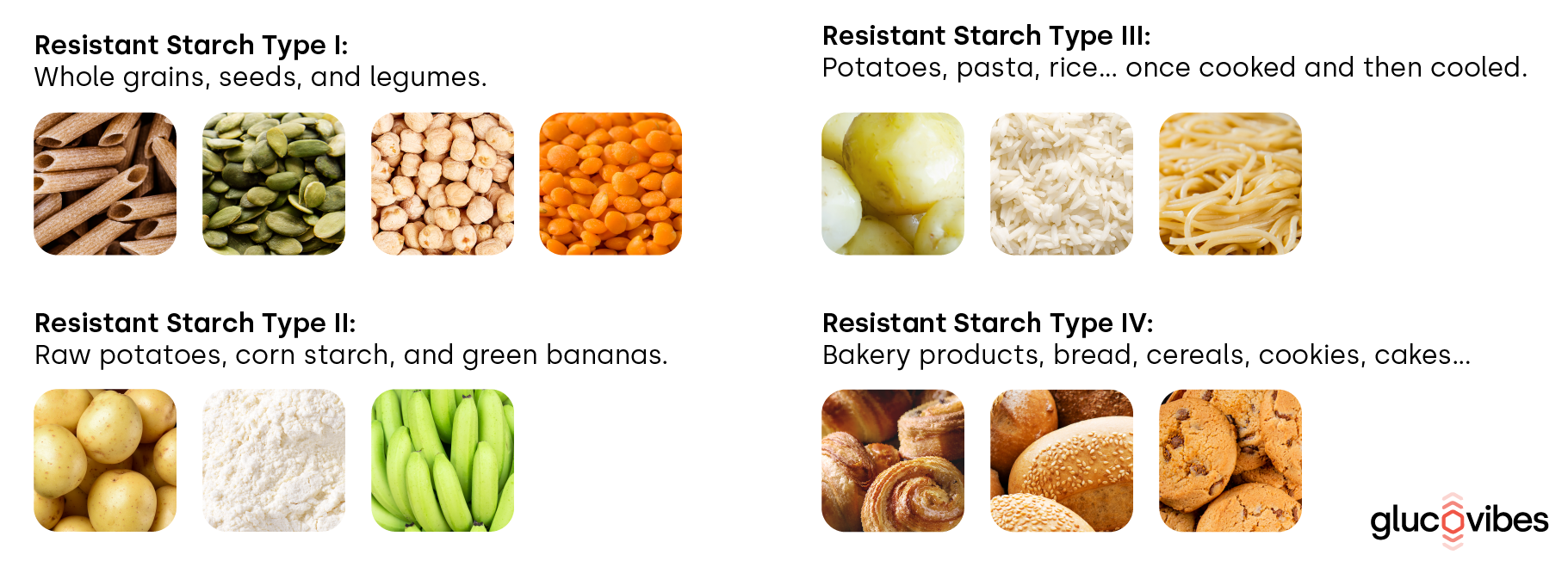
There are different types of starch, and they are classified into four groups:
- Type I: This type of starch is indigestible because it is contained within plant cell walls, which are not digestible (2). By reducing the digestibility of the starch, the glycemic response is also reduced since we cannot absorb the glucose from the starch (3). Whole grains, seeds, and legumes fall into this category.
- Type II: This starch is indigestible when raw, but when cooked, most of it becomes digestible, meaning it loses its resistant properties (3). Raw potatoes, corn flour, and green bananas are examples of this type (4).
- Type III: Known as retrograded starch, this type forms when cooked starch is cooled. Examples include cooked and then cooled potatoes, bread, rice, and cornflakes (4). This type of starch is particularly interesting due to its thermal stability and preserved nutritional functionality (5).
- Type IV: This is chemically modified starch that alters its structure, making it partially resistant to enzymatic hydrolysis, or in other words, more resistant to enzymes (2). It is found in some processed products such as baked goods, cookies, and cereals. Despite containing a small amount of resistant starch, these products are not recommended for health due to other ingredients like refined sugars, hydrogenated fats, refined flours, and preservatives.
Health benefits
There has been a lot of discussion about the benefits of resistant starch, and although it has often been associated with more benefits than it actually has, we will look at how it can influence our health.
Microbiota health
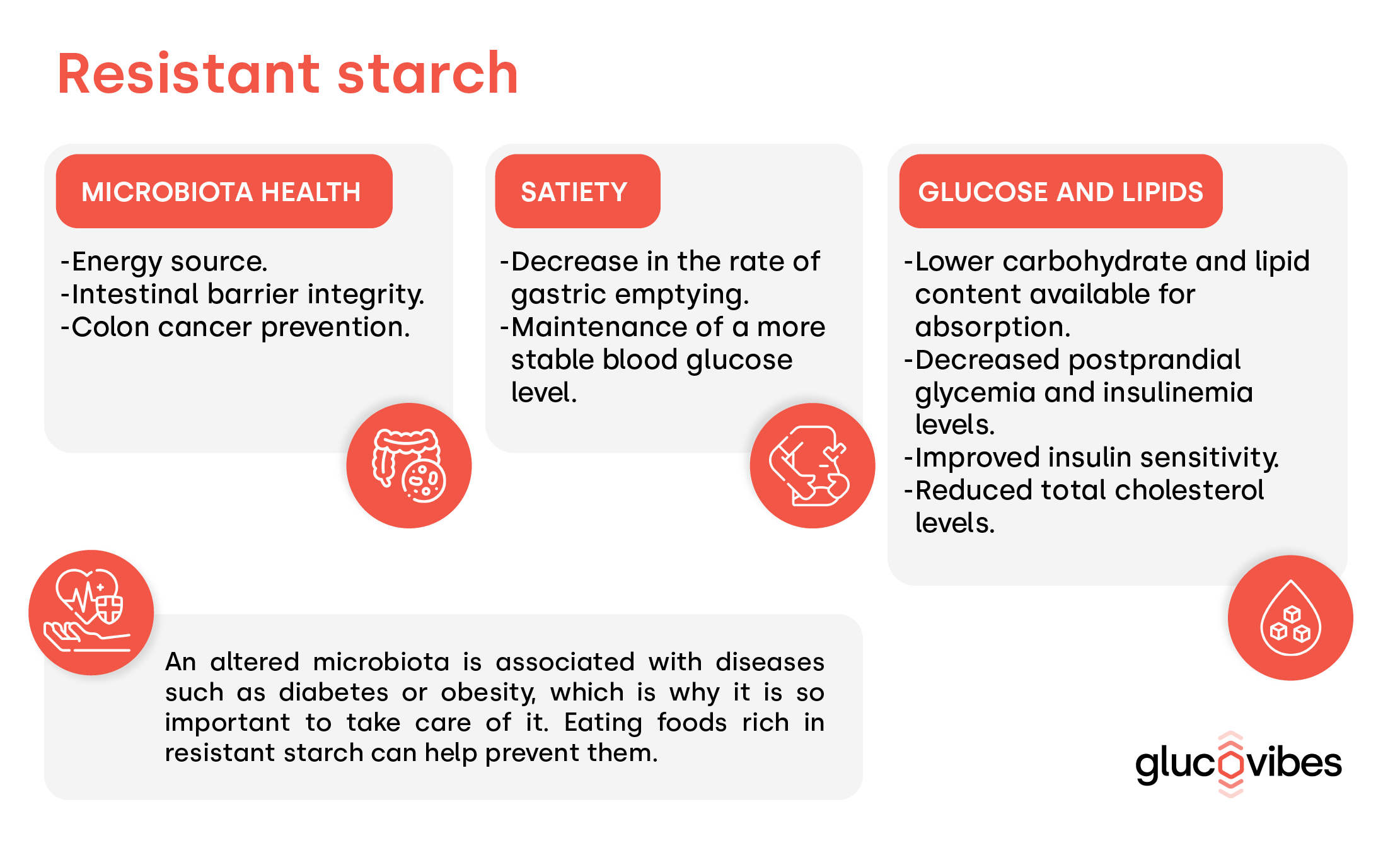
Resistant starch has a prebiotic effect (it acts as food for the human microbiota, meaning it nourishes beneficial gut bacteria) (5). The microbiota in the gastrointestinal tract influences overall health, including immune system development, nutritional acquisition, and protection against infections. A disrupted microbiota is associated with diseases such as diabetes, obesity, inflammatory bowel disease, and colorectal cancer.
Research has shown that consuming resistant starch can help regulate the composition of the microbiota, particularly the groups of microbes that produce butyrate (6).
Given the importance of maintaining a healthy microbiota, it is worthwhile to make small changes in our daily lives to support it, such as increasing the intake of resistant starch. This could involve consuming more foods rich in resistant starch (types I and II) and prioritizing foods rich in carbohydrates (type III) that have been cooled (even if reheated afterward) over those that are freshly cooked.
Satiety
Resistant starch is an excellent source of fiber for providing satiety both in the short term and long term (7). Among the possible mechanisms involved in this response are a decrease in the rate of gastric emptying and the maintenance of more stable blood glucose levels, which have been linked to increased satiety (6). This can be particularly useful as a strategy for weight loss, as this enhanced satiety helps regulate food intake in a physiological manner.
Glucose and lipid metabolism
Human studies have shown that resistant starch reduces postprandial blood glucose and insulin levels and improves insulin sensitivity, likely because there are fewer carbohydrates available for absorption (6). This results in more stable glucose levels and less pronounced spikes, which is beneficial for maintaining good metabolic health.
Resistant starch, like other insoluble fibers, is fermented in the large intestine by the microbiota, producing short-chain fatty acids and other metabolites such as acetate and butyrate. These metabolites have been shown to positively affect insulin sensitivity, meaning that less insulin is needed to achieve the same effect. The slow digestion of resistant starch is also associated with a lower rise in glucose levels (8).
Therefore, combining foods high in simple carbohydrates (with high glycemic loads) with foods rich in resistant starch can lower the overall glycemic load and reduce glucose spikes, while increasing satiety. For example, pairing a ripe fruit (simple carbohydrate) with oats or seeds (rich in resistant starch) can be beneficial.
Research has demonstrated that consuming foods high in resistant starch can improve the glycemic profile in healthy individuals by slowing down starch digestion and lowering the glycemic index of the food (6).
In conclusion, resistant starch helps flatten the glycemic curve and prevents large spikes in blood glucose. Consuming it can be beneficial, as long as it comes from healthy sources, to keep glucose levels stable. However, during exercise, the situation and goals may differ. Pre-sport intake needs to provide sufficient glucose with good absorption to meet increased energy demands, which supports performance and recovery.
References
- [1] Halajzadeh J, Milajerdi A, Reiner Ž, Amirani E, Kolahdooz F, Barekat M, et al. Effects of resistant starch on glycemic control, serum lipoproteins and systemic inflammation in patients with metabolic syndrome and related disorders: A systematic review and meta-analysis of randomized controlled clinical trials. Crit Rev Food Sci Nutr [Internet]. 2020;60(18):3172–84. Available from: https://doi.org/10.1080/10408398.2019.1680950
- [2] Ross SM. Vive la Resistance!: Resistant Starch Supports Blood Sugar and Weight Maintenance. Holist Nurs Pract. 2019;33(3):187–90.
- [3] Birt DF, Boylston T, Hendrich S, Jane JL, Hollis J, Li L, et al. Resistant starch: Promise for improving human health. Adv Nutr. 2013;4(6):587–601.
- [4] Keenan MJ, Zhou J, Hegsted M, Pelkman C, Durham HA, Coulon DB, et al. Role of resistant starch in improving gut health, adiposity, and insulin resistance. Adv Nutr. 2015;6(2):198–205.
- [5] Ma Z, Hu X, Boye JI. Research advances on the formation mechanism of resistant starch type III: A review. Crit Rev Food Sci Nutr [Internet]. 2020;60(2):276–97. Available from: https://doi.org/10.1080/10408398.2018.1523785
- [6] Villarroel Heise P, Gómez C, Vera C, Torres J. Resistant starch: Technological characteristics and physiological interests. Rev Chil Nutr. 2018;45(3):271–8.
- [7] Zaman SA, Sarbini SR. The potential of resistant starch as a prebiotic. Crit Rev Biotechnol [Internet]. 2016;36(3):578–84. Available from: http://dx.doi.org/10.3109/07388551.2014.993590
- [8] Raigond P, Ezekiel R, Raigond B. Resistant starch in food: A review. J Sci Food Agric. 2015;95(10):1968–78.