

Carbohydrates: Do you know what they are and their importance?

Glycogen, starch, carbohydrates, sugar… these are terms frequently used by athletes and nutritionists, but do you really know what you’re referring to when you talk about them? Do you understand what they are and their importance in general life and specifically in athletic performance?
Carbohydrates are a type of macronutrient, just like proteins and fats. Although a balanced diet requires all kinds of nutrients (fiber, vitamins, fats, proteins, etc.), macronutrients are the ones that provide the majority of energy to the metabolic system and are needed in larger amounts.
What are carbohydrates?
Carbohydrates, along with fats, are the primary source of energy for the body. Just as proteins are composed of amino acids and triglycerides are made up of fatty acids, carbohydrates are composed of monosaccharides (the simplest unit of carbohydrates, though not the only form in which they exist).
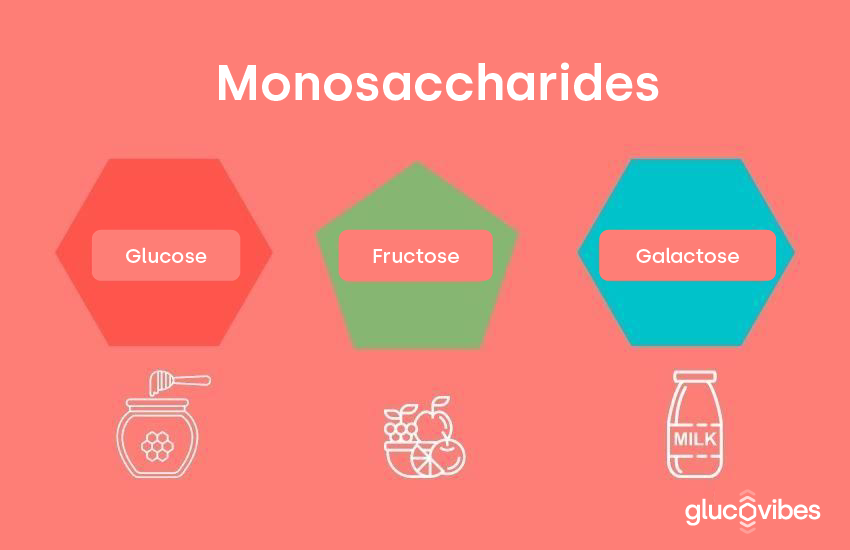
There are three key monosaccharides that are particularly important to us because our bodies can absorb them: 1) glucose, 2) fructose, and 3) galactose. Nearly all carbohydrates we consume are a combination of these three monosaccharides.
While carbohydrates are often associated with pasta, they are also present in many other foods.
Importance of carbohydrates
At Glucovibes, we understand the critical importance of glucose, a common type of carbohydrate. Specifically, it is vital for the proper functioning of the body. Daily, your brain and red blood cells consume around 100-120 grams of glucose. Glucose can be obtained externally (by consuming foods containing it) or synthesized internally by your body.
Red blood cells, lacking mitochondria, cannot use fats as fuel (since fats can only be oxidized within mitochondria). Consequently, they rely on glucose for energy because glucose does not require mitochondria to be converted into energy.
On the other hand, under normal conditions, the brain primarily uses glucose for energy, except during prolonged fasting or ketogenic diets (diets with very low carbohydrate intake). In these cases, the brain adapts to using ketone bodies as an energy source (3).
Additionally, glucose can be stored as glycogen in the liver and muscles for later use, especially during intense physical exercise (4). Here, two factors must be considered:
- Intensity: Higher intensity exercises lead to greater glycogen usage.
- Duration: Longer exercise durations result in increased glycogen consumption.
Classification of carbohydrates
You’ve probably heard about simple carbohydrates, starch, sugars, complex carbohydrates, and glycogen more than once. These terms are often confused with one another. We’ll briefly and simply explain what each one means.
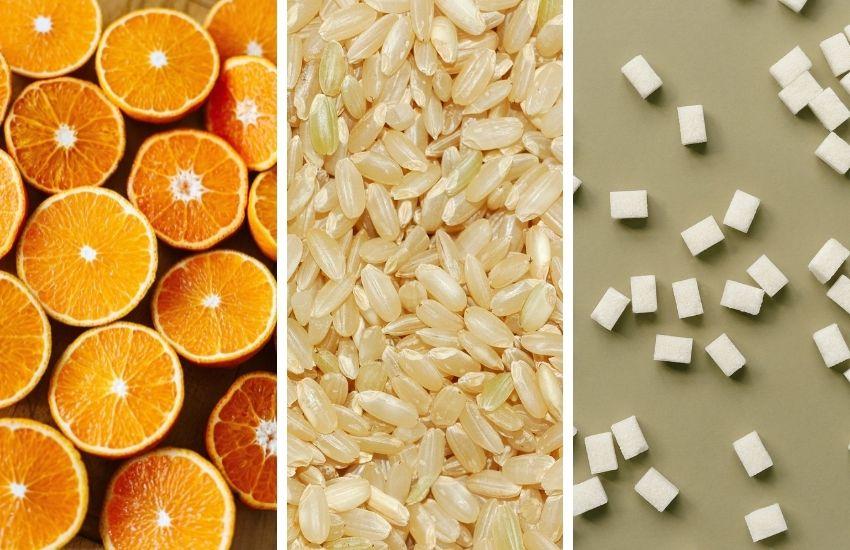
All of these foods contain carbohydrates.
Monosaccharides
- Glucose: It is the monosaccharide that can be used by almost all the cells in the body to obtain energy.
- Fructose: Its metabolism is completely different from that of glucose. Fructose is metabolized exclusively in the liver (1). It is the characteristic sugar of fruits, though most of the fructose we consume comes from sugary foods (you will soon understand why).
- Galactose: Like fructose, it is metabolized in the liver. It is found in dairy products, forming part of lactose.
Disaccharides
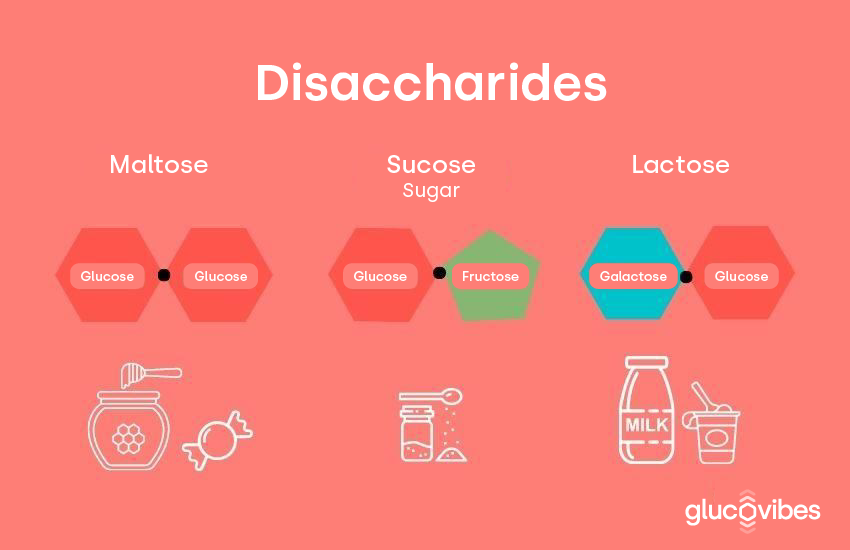
Disaccharides are essentially the union of two monosaccharides. Similar to monosaccharides, there are three notable disaccharides:
- Sucrose: This disaccharide is made up of one glucose unit and one fructose unit. It is commonly known as table sugar and is used to sweeten foods and beverages like coffee.
- Maltose: This is formed by the combination of two glucose units.
- Lactose: This disaccharide consists of one glucose unit and one galactose unit. Lactose can often cause gastrointestinal issues.
Interestingly, our bodies are unable to absorb disaccharides and polysaccharides directly. Instead, we absorb only the simplest units, namely the individual monosaccharides (glucose, fructose, galactose).
During digestion, the bonds between monosaccharides are broken, freeing them for absorption. People who are lactose intolerant have a deficiency in the enzyme lactase (2). This enzyme’s role is to break the bond between glucose and galactose so that they can be absorbed separately by the body.
Due to this enzyme deficiency, lactose cannot be absorbed in the small intestine and continues to the large intestine. Here, it is fermented by intestinal bacteria, leading to gastrointestinal discomfort. Now, you can understand lactose intolerance much better!
Polisaccharides
You can intuit that a polysaccharide is made up of many monosaccharides linked together (since “poly” means many). Simple, right? In part, yes, but there’s a technical aspect to consider.
Unlike mono- and disaccharides, which are composed of glucose, fructose, and galactose, polysaccharides such as starch and glycogen are formed by long chains of glucose units linked together. It’s true that there are also polysaccharides made of fructose chains, known as fructans, but today’s focus will be on starch and glycogen.
Starch and glycogen are polysaccharides that both humans and plants use to store glucose.
- Starch: This is how plants store glucose. Foods like rice, potatoes, sweet potatoes, oats, and legumes are rich in carbohydrates, specifically starches. Essentially, you are consuming long chains of glucose.
- Glycogen: This is how humans store glucose. We store glycogen in the liver (hepatic glycogen) and in the muscles (muscle glycogen).

There are many myths about carbohydrates, and sometimes even fear, as they are often associated with weight gain. However, this is far from the truth. Carbohydrates are essential macronutrients for our vital functions. Foods containing carbohydrates do not pose a significant issue for maintaining good health and a balanced weight as long as they are part of a complete diet rich in other nutrients. We’ve already highlighted their importance for the proper functioning of red blood cells and the brain, as well as for athletic performance.
If you want to delve deeper into this topic and receive expert nutrition advice to better understand how foods affect you, we recommend trying Glucovibes.
References
- [1] Hengist A, Koumanov F, Gonzalez JT. Fructose and metabolic health: governed by hepatic glycogen status? Vol. 597, Journal of Physiology. Blackwell Publishing Ltd; 2019. p. 3573–85.
- [2] DI Costanzo M, Berni Canani R. Lactose Intolerance: Common Misunderstandings. Ann Nutr Metab. 2019;73(Suppl 4):30–7.
- [3] Jensen NJ, Wodschow HZ, Nilsson M, Rungby J. Effects of ketone bodies on brain metabolism and function in neurodegenerative diseases. Int J Mol Sci. 2020;21(22):1–17.
- [4] Brooks GA. The precious few grams of glucose during exercise. Vol. 21, International Journal of Molecular Sciences. MDPI AG; 2020. p. 1–19.