

Nutrition and Glucose: factors that affect blood glucose levels

Good morning! Today, we have a new blog that will interest you. We’ve previously discussed the metabolic bases of glucose levels and the factors related to physical activity that influence them, but what do you know about nutrition and glucose levels? Do you know how what you eat affects your glucose? If you want to learn more, you’re in the right place.
Nutrition is fundamental to our daily lives, as we cannot survive without eating. A good diet is linked to health and well-being, so it’s important to understand our bodies and how foods affect us. In this blog, we will focus on the nutritional factors that impact glucose levels (remember, this refers to the concentration of glucose in the blood).
Carbohydrate intake
Carbohydrates are the primary source of energy in our diet and have the most significant impact on our blood glucose levels. Briefly, our body breaks down carbohydrates into glucose, which is the main energy source for our cells, tissues, and organs. Glucose is stored in the liver and muscles to be used when needed. There are two types of carbohydrates:
Simple Carbohydrates: These are quickly broken down by the body for immediate energy. Because they are metabolized and absorbed rapidly, they cause the most significant spikes in blood glucose levels (~160 mg/dL, though this can vary). Examples include sugar, processed and refined sweets, fruit, milk, and its derivatives.
Complex Carbohydrates: These have long chains of glucose in their chemical structure, which means they take longer to be metabolized by the body than simple carbohydrates. As a result, they produce a smaller peak in blood glucose levels (~120 mg/dL, though this can depend on the individual). Examples include legumes, tubers, and vegetables.
Therefore, the choice and intake of carbohydrates influence the glycemic response. It is not about classifying which is “better” or “worse,” but rather understanding their effects and how appropriate they are in different contexts.
Additionally, proteins and fats also affect glucose levels, though to a lesser extent. For proteins, the impact on blood glucose is minimal, meaning that with protein intake, the glucose curve will be nearly linear (~37 mg/dL). However, the response may differ between isolated proteins, such as those from powder supplements, and meals rich in protein. Similarly, moderate fat intake has a minimal effect on blood glucose levels (1).
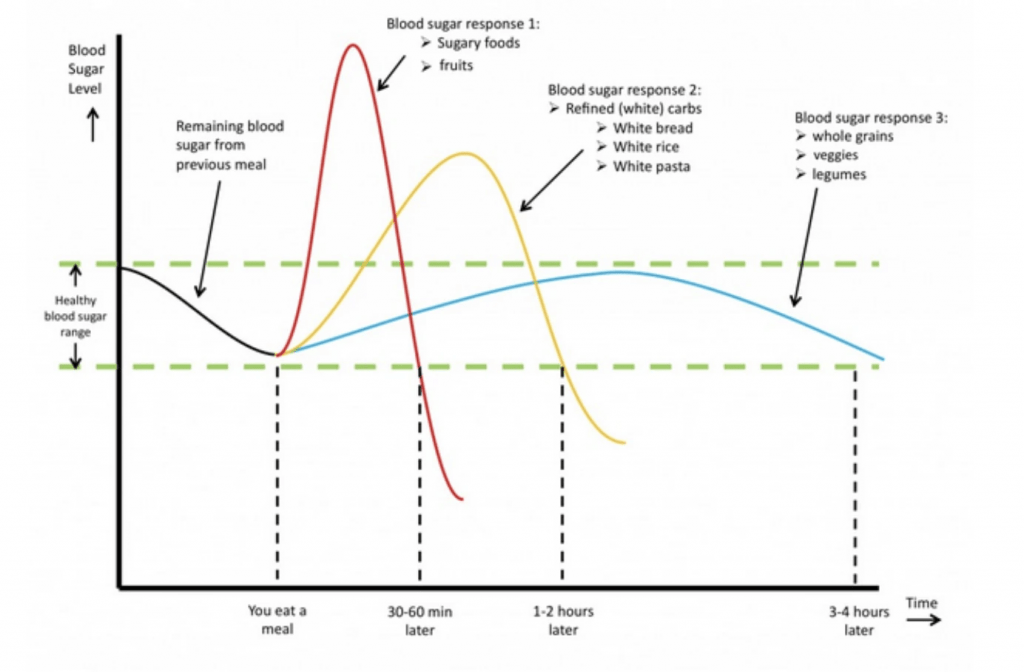
In summary, carbohydrates are the macronutrient that most significantly affects blood glucose levels, whereas proteins and fats have a minimal impact.
Glycemic index of foods
Secondly, we have the glycemic index (GI), but why are we discussing it? The glycemic index (GI) was the first term used to measure the impact of dietary carbohydrates on blood glucose levels. It not only helps regulate appetite and control body weight but is also directly related to cardiovascular diseases, inflammatory conditions, diabetes, and some cancers. Therefore, it is an important factor to understand. So, what does it mean?
The glycemic index of foods was developed to systematically classify carbohydrates into different groups based on their effects on postprandial glucose levels over time. Foods with high GI values are digested and absorbed more quickly, leading to greater fluctuations in blood glucose levels per unit of carbohydrate.
The GI is methodologically defined as the incremental area under the curve (AUC) of the blood glucose response after consuming a carbohydrate-containing food compared to a reference food with an equivalent amount of carbohydrates (2).
But what are the values that indicate whether a food has a high, medium, or low GI? (3)
- Low GI (≤ 55): Examples include nuts, whole dairy products, dark chocolate, apples, kiwi, legumes, and non-starchy vegetables.
- Medium GI (56-69): Examples include ripe bananas, melons, fruit juices, jams, corn, and muesli.
- High GI (≥ 70): Examples include popcorn, honey, cookies, white bread, industrial pastries, white and brown sugar, soft drinks, dates, boiled carrots, potato chips, rice, and breakfast cereals.
Thus, simple carbohydrates, previously mentioned, are foods with the highest GI. For this reason, they have the potential to create the highest and most rapid peak in blood glucose levels.
Food combinations
Despite emphasizing the effect of different types of foods and carbohydrates (GI), as well as their quantity, there is a third factor that significantly impacts blood glucose levels: the combination of foods. Typically, we don’t consume isolated foods, and these foods often contain more than one macronutrient; they are usually combinations of carbohydrates, proteins, fats, and other components like fiber or micronutrients. Therefore, even though each food has a specific glycemic index (GI), combining them with other foods creates a different glycemic response. For example, combining carbohydrates with proteins can lower the overall GI of the meal (4).
What does this mean? If, for instance, you eat a plate of white rice with vegetables and chicken, the total GI of the meal will decrease, and consequently, the impact on blood glucose levels will also be reduced.
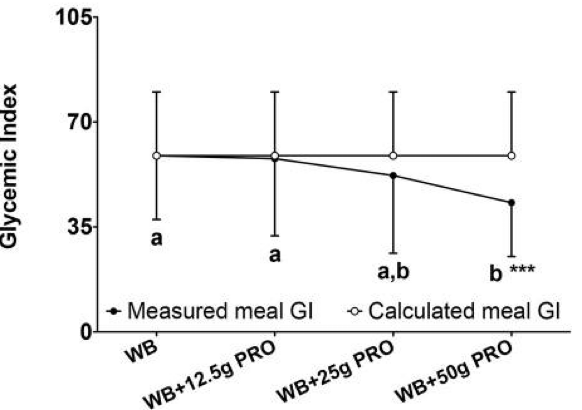
In this context, it’s not only proteins that interact; fats and fiber also influence the glycemic response of meals, albeit to a lesser extent. Fiber intake is associated with better glycemic control as it improves postprandial hyperglycemia by slowing down the digestion and absorption of carbohydrates (5,6). Therefore, using whole foods or combining them with fiber can be a good strategy to achieve a more stable glucose level, as seen on your Glucoboard.
While intake significantly determines glycemia, the effect of foods varies depending on the context, such as physical activity or muscle contraction. For example, the impact of a banana on blood glucose can differ significantly between a resting state and during exercise. This highlights that nutritional “rules” can vary greatly depending on the context. We will explain these metabolic “peculiarities” in the following posts.
Conclusions
Therefore, carbohydrates are the macronutrient that most affects the glycemic response, as they have the highest glycemic index of all foods. However, this response can be reduced by combining carbohydrates with proteins, fats, or fiber. These components interact in the digestion and absorption of carbohydrates, thereby better modulating blood glucose levels.
If you want to keep learning, follow Glucovibes and become a glucose expert.
Thank you for reading, and see you next time!
References
- [1] Franz J. Protein: Metabolism and Effect on Blood Glucose Levels. Nutrition Update. 1997 Nov;23(6).
- [2] Brand-Miller JC, Stockmann K, Atkinson F, Petocz P, Denyer G. Glycemic index, postprandial glycemia, and the shape of the curve in healthy subjects: analysis of a database of more than 1,000 foods. Am J Clin Nutr. 2009 Jan;89(1):97-105.
- [3] Murillo S. Tabla de Raciones de Hidratos de Carbono. Fundación para la Diabetes. 2013 Abril.
- [4] Meng H, Matthan NR, Ausman LM, Lichtenstein AH. Effect of macronutrients and fiber on postprandial glycemic responses and meal glycemic index and glycemic load value determinations. Am J Clin Nutr. 2017 Apr;105(4):842-853.
- [5] Gaesser GA, Rodriguez J, Patrie JT, Whisner CM, Angadi SS. Effects of Glycemic Index and Cereal Fiber on Postprandial Endothelial Function, Glycemia, and Insulinemia in Healthy Adults. Nutrients. 2019;11(10):2387.
- [6] Fujii H, Iwase M, Ohkuma T, et al. Impact of dietary fiber intake on glycemic control, cardiovascular risk factors and chronic kidney disease in Japanese patients with type 2 diabetes mellitus: the Fukuoka Diabetes Registry. Nutr J. 2013;12:159.