

And why would I want to measure my blood sugar?

You might be asking yourself: ‘I don’t have diabetes, so why would I want to continuously monitor my blood glucose?’ And while we must acknowledge that it’s a very good question, the answer is quite simple: because you care about your metabolic health and want to take care of yourself. Monitoring your glucose helps you get to know yourself better so you can learn how to eat and move in a way that supports a balanced life, helping you achieve all your goals.
Although generally everyone knows that we need to watch what we eat, few people delve into the ‘why’—how our body works internally and why it processes food the way it does. The intake of different foods causes changes in our blood glucose curve, and there is growing evidence linking high postprandial glucose levels (that is, after meals) to various diseases, such as cardiovascular disease (CVD) or type 2 diabetes (T2D) (1,2). In other words, by controlling and understanding our glycemic response after meals, we can improve this curve, take care of our metabolic health, and prevent these diseases. Metabolic health is nurtured by eating well.

What is metabolic health?
Metabolic health, in terms of glucose levels, is characterized by 1) the ability to maintain relatively stable blood glucose concentrations in the postprandial state and 2) the speed at which glucose normalizes after intake. This is because sustained high postprandial glucose concentrations are associated with increased risk of cardiovascular disease (CVD), coronary artery disease (CAD), prediabetes, type 2 diabetes (T2D), and cardiovascular mortality, even in individuals with normal fasting glucose levels (1,2,3).
Now, there are times when the glucose curve experiences variations that are completely natural, such as the increase in glucose levels after consuming foods containing carbohydrates and fats, respectively. This rise is entirely physiological (what should concern you is a very pronounced increase in glucose levels after meals and the inability for this curve to decrease—glucose clearance). That tempting snack with a lot of sauce won’t affect her the same way it affects him.

It is curious that there is significant interindividual variability in postprandial glucose levels in response to the same dietary intake; that is, the same meal in the same quantities may not affect one person the same way it affects another. Similarly, that same meal might affect the same person differently if consumed on an empty stomach or after a period of exercise.
This significant variability in response to identical intakes suggests that universal dietary recommendations have limited utility as they do not produce the same postprandial responses in different people (2). For example, a single food item might raise one person’s postprandial glucose levels to 115 mg/dL while causing another’s to rise to 205 mg/dL. Unless you measure glucose levels continuously, you won’t know which foods help you maintain relatively stable postprandial glucose levels and avoid pronounced increases. Glucovibes serves as support for personalized nutrition to monitor this.
How do I measure glucose continuously?
The continuous glucose monitor (CGM) is a device that allows you to track glucose levels in the interstitial fluid (liquid that surrounds the cells) 24 hours a day. These CGM systems vary in their data measurement frequency, ranging from every 15 or 20 minutes to minute-by-minute, depending on the model and measurement method.
Glucovibes uses this technology to measure your glucose levels and includes this data in an innovative app that not only monitors your blood glucose but also considers other parameters such as diet, rest, and activity to provide advice and suggest improvements to help you achieve all your goals.
After a measurement, which we refer to as getting a “vibe” because the phone vibrates when scanning the sensor, you will see data for each minute over the last 15 minutes and data every 15 minutes for the past 8 hours. This scanning is done using NFC technology, similar to making a contactless payment with your mobile phone. To check and understand your glucose levels, you only need to bring your mobile close to the glucose sensor, and the value will appear in your Glucovibes app. By doing this once every 8 hours, you won’t miss any data from the 24 hours of a day, providing continuous monitoring of your blood glucose levels. Simple, right?
Personalized nutrition
It is very likely that you’ve heard the expression “everyone is a world of their own,” and like all sayings, it has its truth. We are all different both physically and mentally. The same applies physiologically. We are different and respond differently to the same stimulus, for example, the same workout or the same meal. Continuously measuring your glucose along with a good intake and nutrition tracking app allows you to know your glucose levels throughout the day (including postprandial glucose). Given the variability in glycemic response between individuals, understanding how you respond to a specific intake can greatly help improve your metabolic health. Here’s an example:
Imagine we have two people (Itxaso and Aitor), and we want to know their postprandial glucose levels with two specific foods (banana and cookies). We use the same foods in both cases and provide the same amount of carbohydrates. At first glance, you might think the glycemic response will be very similar in Itxaso and Aitor.
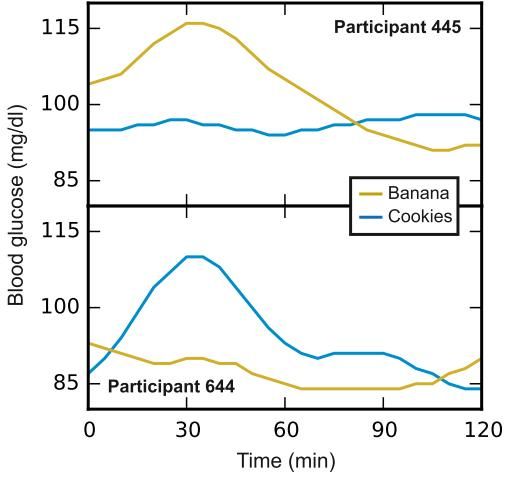
But this doesn’t have to be the case, and in fact, it often isn’t. If you look at Figure 1 from the study by Zeevi et al. (2), you’ll see how glycemic responses to the same food can vary between different people. In fact, they can even produce almost opposite effects. For Itxaso, the banana causes a higher glycemic response, while for Aitor, it’s the cookies that lead to a higher response. This is just a simple example to illustrate the physiological differences between individuals.
In this example, the banana and cookies are not comparable in terms of total macronutrients, vitamins, and fiber, but it’s possible that for you, white pasta from one supermarket could produce a much higher glycemic response compared to white pasta from another supermarket. To determine which one results in a lower postprandial glucose level, a device is needed to continuously monitor glucose levels.
Another example of how Glucovibes helps us understand how each food affects us based on what it’s paired with is shown in this graph:
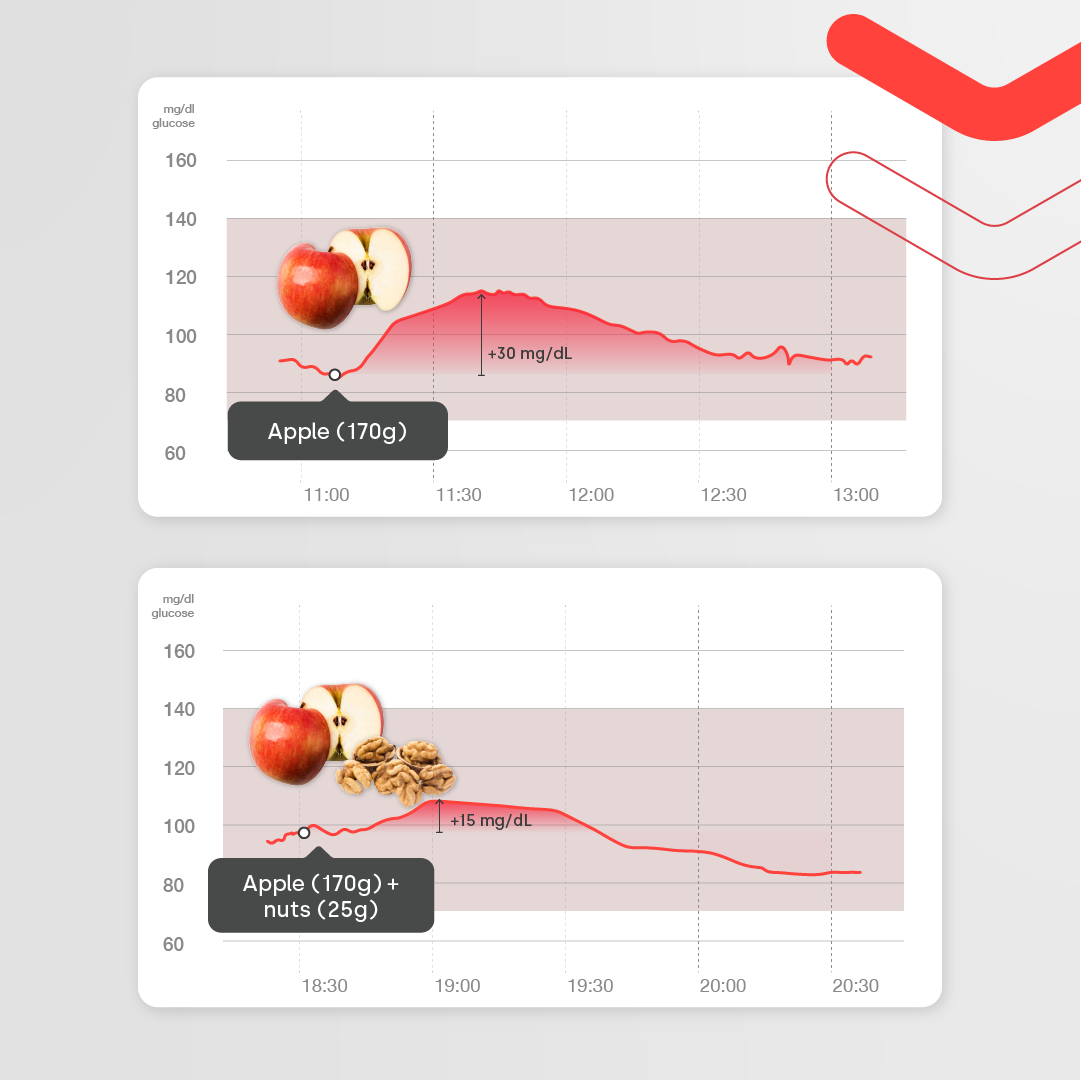
In the graphs, we see how the same food can have different effects depending on whether it is accompanied by nuts or not. Fats contribute to glucose regulation. If we pair carbohydrates (apple) with healthy fats (nuts), the rate at which glucose enters the bloodstream is lower, resulting in a more moderated peak.
There is increasing evidence linking high postprandial glycemic responses to non-communicable diseases such as cardiovascular disease (CVD), prediabetes, type 2 diabetes (T2D), and even coronary death. For this reason, continuously monitoring glucose levels is of great interest.
Glucovibes is a very useful tool for personalizing nutrition to identify which foods produce lower postprandial glucose levels, thereby improving your metabolic health.
So, what do you think now? Do you believe it’s worthwhile to measure glucose levels?
References
- [1] Gonzalez JT, Betts JA. Dietary sugars, exercise and hepatic carbohydrate metabolism. In: Proceedings of the Nutrition Society. Cambridge University Press; 2019. p. 246–56.
- [2] Zeevi D, Korem T, Zmora N, Israeli D, Rothschild D, Weinberger A, et al. Personalized Nutrition by Prediction of Glycemic Responses. Cell. 2015;163(5):1079–94.
- [3] Berry SE, Valdes AM, Drew DA, Asnicar F, Mazidi M, Wolf J, et al. Human postprandial responses to food and potential for precision nutrition. Nat Med [Internet]. 2020;26(6):964–73. Available from: http://dx.doi.org/10.1038/s41591-020-0934-0