

Benefits of resistant starch on glycemia and microbiota
Good morning, Vibers! Previously, we discussed what resistant starch is and where to find it. However, it is increasingly being labeled with various benefits: preventing colon cancer, acting as a prebiotic, being a probiotic, controlling blood lipids, reducing appetite, and causing less weight gain. There are still many questions about its benefits, so today we’ll clarify them by focusing on its effects on blood glucose levels and the microbiota.
Is starch the same as resistant starch?
Let’s review the difference between regular starch and resistant starch. When regular starch is digested, glucose is released and quickly absorbed by the body. In contrast, resistant starch (RS) is a part of the starch molecule and is highly resistant to digestion, making it a nutrient with slow and difficult absorption.
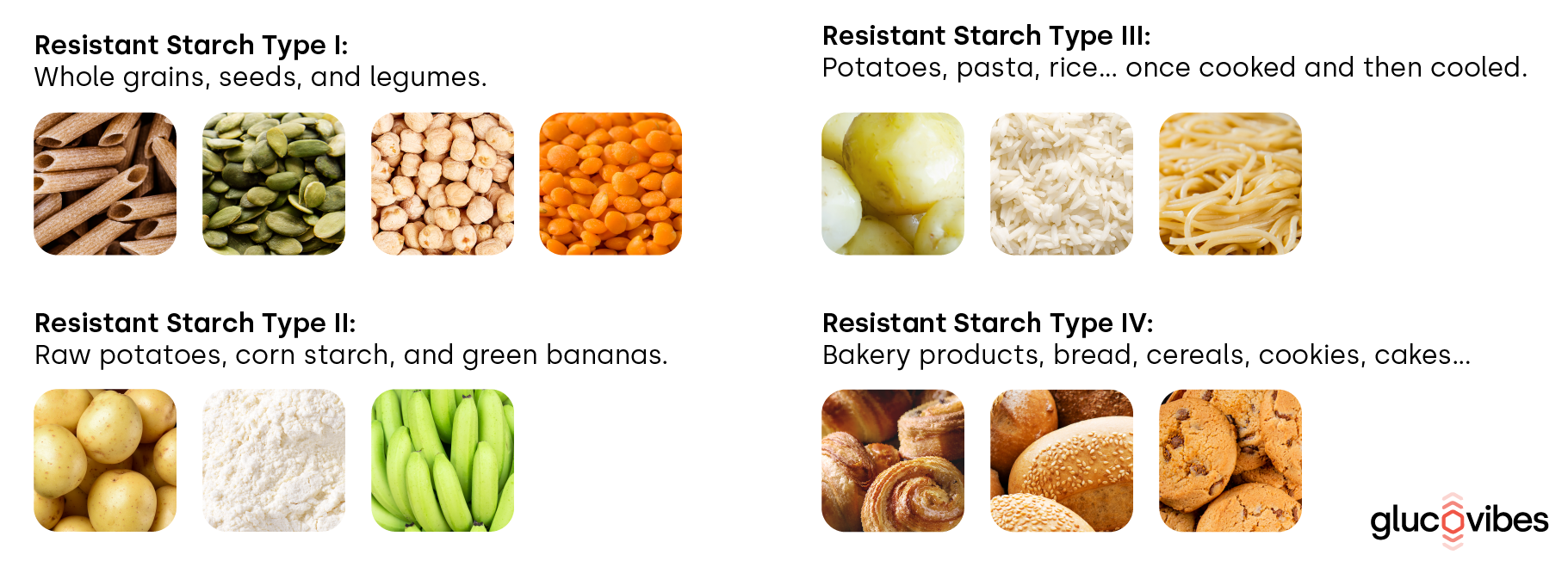
Here’s a reminder of the different types of resistant starch and the foods that belong to each group:
- Resistant Starch Type I: Whole grains, seeds, and legumes.
- Resistant Starch Type II: Raw potatoes, corn starch, and green bananas.
- Resistant Starch Type III (or Retrograded): Potatoes, pasta, rice… once cooked and then cooled.
- Resistant Starch Type IV: Bakery products, bread, cereals, cookies, cakes…
The easiest way to obtain resistant starch is by refrigerating cooked rice, pasta, and tubers. For example, cooked rice that has been left at room temperature for 4 hours contains 0.64g of resistant starch per 100g. However, if the same rice is refrigerated for 24 hours at 4ºC, the amount of resistant starch doubles. In this latter case, the amount of digestible carbohydrate is reduced, leading to a lower impact on blood glucose levels.
Blood glucose and resistant starch
Once we’ve clarified what starch is and its characteristics, let’s discuss how its consumption affects blood glucose levels. As mentioned earlier, the main characteristic of resistant starch is its difficulty in digestion. Resistant starch is digested slowly throughout the small intestine, resulting in a gradual and prolonged release of glucose into the bloodstream.
What does this mean? If we consume a food with resistant starch, the glucose transfer to the blood will be slower, and thus, the peak in blood glucose levels will be lower.
📲 Stay tuned to our instagram because next week we’ll share a real-life case to help you understand this better.
Numerous studies have shown that resistant starch helps keep postprandial (after eating) glucose levels more stable compared to regular starch. Therefore, consuming resistant starch can be a good ally for individuals with prediabetes or type 2 diabetes.
Microbiota and resistant starch
In recent years, the microbiota has been highlighted as an important factor affecting health, and resistant starch plays a significant role in it.
Resistant starch has a prebiotic effect because, not being digested or absorbed in the stomach, it reaches the colon intact, where the bacteria present feed on it. The bacteria in the human colon ferment resistant starch, resulting in short-chain fatty acids (SCFAs), primarily acetate, propionate, and butyrate.
Resistant starch is considered one of the types of fiber that produces the most butyrate as a result of its fermentation in the intestine, with butyrate being the preferred substrate for colonocytes (colon cells).
However, each individual’s response to the intake of the same amount and type of resistant starch can vary, as each person’s microbiota composition is unique and may be made up of different bacteria. Therefore, it’s important to consider each specific case to achieve these benefits.
Conclusions
The main characteristic of resistant starch is its very slow digestion. For this reason, it helps to maintain more stable blood glucose levels and, on the other hand, reaches the colon where it serves as food for beneficial bacteria in the gut microbiota, thus acting as a prebiotic.
As we have seen, it can be a very interesting and beneficial addition to the diet, especially for individuals with insulin resistance or diabetes.
References
- [1] Keenan, MJ., Zhou, J.et al. Role of resistant starch in improving gut health, adiposity, and insulin resistance.Adv Nutr [internet]. 2015; 6(2), 198–205.
- [2] Sonia, S., Witjaksono, F. Ridwan, R. Effect of cooling of cooked white rice on resistant starch content and glycemic response. Asia Pac J Clin Nutr [internet]. 2015; 24(4), 620–625.
- [3] Wang Y, Zhou X, Xiang X, Miao M. Association of Slowly Digestible Starch Intake with Reduction of Postprandial Glycemic Response: An Update Meta-Analysis. Foods [internet]. 2022;12(1):89.
- [4] Dobranowski PA, Stintzi A. Resistant starch, microbiome, and precision modulation. Gut Microbes [internet]. 2021; 13(1):1926842.
- [5] DeMartino P, Cockburn DW. Resistant starch: impact on the gut microbiome and health. Curr Opin Biotechnol [internet]. 2020; 61:66-71.