

Effects of physical exercise on glycemia

Hello everyone! Today we bring you a post on how physical exercise affects glycemia. We’ll start by explaining in simple terms the two key characteristics necessary for muscle contraction. We’ll also cover how the intensity of physical exercise impacts glycemia and finally how the timing of food intake and movement affect blood glucose levels. If you want to learn about physical exercise and its effect on your glycemia, keep reading—it’s going to be interesting. Let’s get started!
Muscle contraction and glycemia
VibeBattery is your daily energy. It is a mathematical relationship between various objective and subjective variables that represents your body’s state in handling life’s different stimuli.
While you don’t need to strictly follow this indicator, it gives you a very precise idea of how your body is at that moment to face the day ahead. Green VibeBattery: you can handle everything: your rest has been good, your glucose levels are stable, and you’ve had sufficiently nutritious intakes. Red VibeBattery: you might need to approach the challenges ahead with more caution today.
For physical exercise, it is necessary to generate muscle contraction followed by the relaxation of the same muscle. This process needs to be continuous; for example, if you go running and after contracting a muscle you cannot relax it, you wouldn’t be able to continue running.
Muscle contraction is a complex process that is perfectly synchronized. For it to occur, two processes are required (though it is more complicated, we’ll simplify it to two processes for clarity). First, muscle contraction begins with a nerve impulse that stimulates the muscle fibers. Second, there must be the release of calcium ions (Ca2+) from the sarcoplasmic reticulum (the place where Ca2+ is stored in the muscle cell). Once these two conditions are met, muscle contraction can occur, which requires energy in the form of ATP. Changes in the concentration of Ca2+ in muscle cells lead to the activation of signaling cascades that influence cellular metabolism, including glucose uptake (1). This results in increased glucose uptake by the muscle, which lowers blood glucose levels. To maintain these levels within appropriate ranges, our body will need to react in various ways.
Intensity
Exercise intensity is the factor that most influences blood glucose levels (2). It can be measured in various ways, including heart rate (HR), rate of perceived exertion (RPE), speed, power, or VO2max. Of these methods, we highlight two in particular for their simplicity: HR and RPE. But how does exercise intensity affect blood glucose? I think a concrete example will help illustrate this better.
Imagine this afternoon you’ve decided to go for a walk. You connect your headphones to your phone and hit play on your favorite Spotify playlist. You start walking in the nearest park. The muscles in your legs begin to contract and relax, making it possible for you to complete your planned walk. At this moment, the constant muscle contraction in your legs causes an increase in the translocation of GLUT4 (glucose transporter) to the surface of your muscles, resulting in a slight drop in blood glucose levels. The translocation of GLUT4 to the muscle surface is regulated by two synergistic mechanisms: insulin and muscle contractions (3). During exercise, translocation is primarily due to muscle contractions, as insulin secretion is reduced compared to resting conditions. Additionally, various factors such as increased temperature, elevated glucose concentration, and increased blood flow facilitate glucose uptake. You feel energized and decide to increase your walking speed (increasing exercise intensity) to a moderate level. At this point, your liver has noticed the slight decrease in blood glucose and, through various mechanisms, initiates compensatory processes to return glucose levels to normal. This compensatory mechanism is known as hepatic glycogenolysis (breakdown of stored glycogen in the liver). Suddenly, your favorite song starts playing, you get motivated, and you begin to run (further increasing exercise intensity). You feel euphoric and ramp up the intensity to 70-80% of your maximum HR. As mentioned in the previous post, during moderate to high-intensity exercise, a physiological response in the human body is to elevate blood glucose (glucose available to the muscles), potentially reaching levels even higher than 160-180 mg/dL (4,5). You finish the song and turn around to walk back home.
What we want to convey with this example is that at the beginning of exercise, there may be a slight drop in glucose levels (which is completely physiological), and as exercise intensity increases, glucose levels rise due to increased glucose transport and utilization by the muscles (a physiological effect). To counteract this effect, the liver releases more glycogen to maintain stable glucose levels. In other words, various signals are activated to increase glucose flow to active tissues (muscles). With this practical example, we hope you have a clear understanding of how exercise intensity affects blood glucose levels.
Timing of food intake and exercise to regulate blood glucose
As we discussed in previous sections, physical exercise has a significant impact on blood glucose regulation, whether you eat before or after exercising. However, the underlying explanations differ somewhat. In this section, we will explain two possible scenarios and how the timing of food intake and exercise affects blood glucose regulation.
Pre-exercise food intake
Imagine this scenario: You’ve just arrived home from work at 4:00 PM. It’s Monday, and as every Monday, you plan to run 10 km at a pace of 4:00/km. Before heading out for your run, you decide to have a pre-workout snack consisting of a medium banana and 8 rice cakes (approximately 60g) with 40g of jam. This pre-workout snack is almost exclusively made up of easily digestible carbohydrates. You wait 30-45 minutes after finishing the snack before you start running. At the beginning of your exercise, it’s possible that your blood glucose levels may drop slightly due to increased glucose transport to the muscles caused by muscle contractions. However, in this case, after consuming a carbohydrate-rich snack, these carbohydrates will stimulate the release of insulin. Insulin, in turn, promotes the translocation of GLUT4 to the muscle surface. This results in a synergistic effect of insulin and muscle contractions, increasing glucose transport into the muscles and lowering blood glucose levels. Additionally, because you had a carbohydrate-rich snack in the hour before exercising, there will be an increased oxidation of total carbohydrates, a suppression of liver glycogen utilization, and a reduction in fat oxidation (2). This makes sense, as the carbohydrates you consumed in your pre-workout snack will be used as the primary energy source during your workout, rather than relying on the stored glycogen in your muscles.
Post-exercise food intake
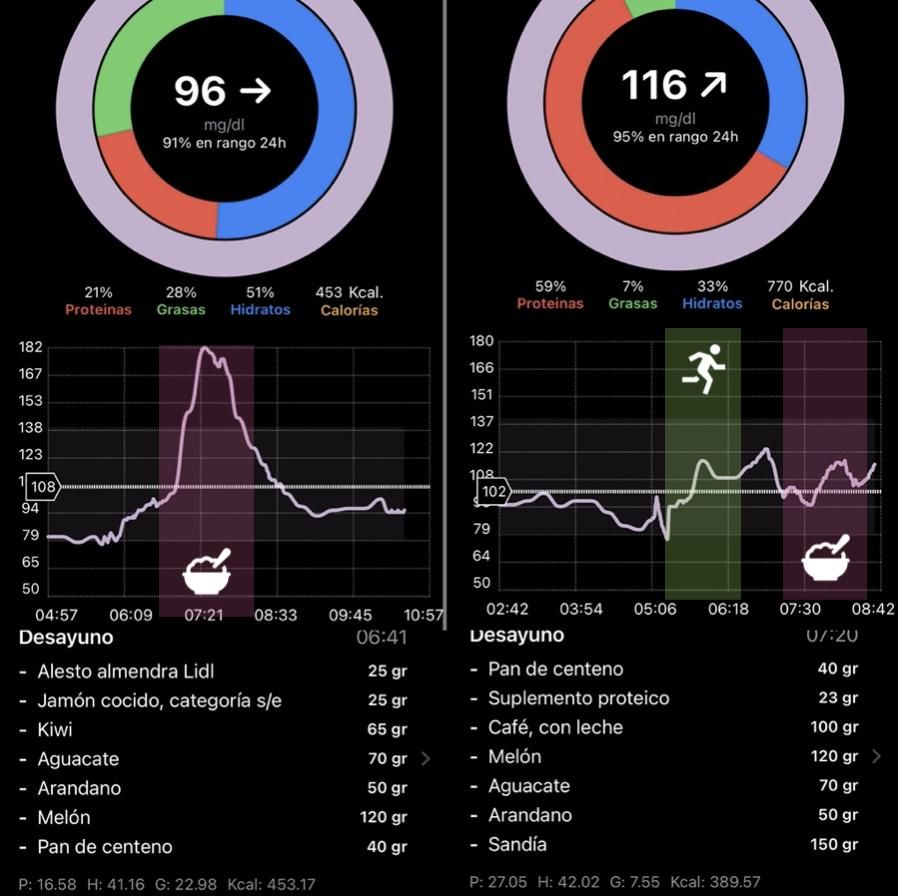
After finishing your workout, you feel exhilarated and decide to have a post-workout snack to boost recovery, as you have another sport (cycling, for example) scheduled for Tuesday. The snack consists of 120g of toast with 80g of serrano ham and 40g of tomato sauce (primarily adding carbohydrates and protein). How does this affect your blood glucose levels? Well, since you’ve just completed a moderate-to-high intensity workout, most of the glucose will be stored in the muscles as glycogen. This is because, during the effort, the main source of energy was the glucose from your pre-workout snack and muscle glycogen. If we focus solely on blood glucose levels, they will be elevated by the post-workout snack, but this increase will be much less pronounced than if you hadn’t gone for your run. You can see a real-life graphical representation in Figure 1 when comparing Alberto’s blood glucose levels. The image on the left shows Alberto’s blood glucose levels during Monday morning. You can see that right after waking up, he consumes a meal (breakfast), with the nutritional value displayed at the bottom of the image. On the right, you can see Alberto’s blood glucose values on Tuesday morning. In this case, he performs a workout (running in a fasted state) at an RPE of 6-7. The nutritional value of the breakfast he has after the workout is shown at the bottom of the image. Although the breakfast is not exactly the same, it is very similar, particularly in the amount of carbohydrates. You can observe how the blood glucose response is less pronounced when exercise has been performed beforehand.
Conclusions
With this post, you’ve learned that physical exercise is a great ally for managing blood glucose levels, whether you exercise before or after eating. We hope you take away one key message from this post:
Engaging in physical exercise before or after a meal helps maintain more stable blood glucose levels and results in a less pronounced increase in glucose.
We hope this information is useful and helps you understand a bit better how physical exercise affects blood glucose levels.
References
- [1] Röhling M, Herder C, Stemper T, Müssig K. Influence of Acute and Chronic Exercise on Glucose Uptake. J Diabetes Res. 2016;2016.
- [2] Gonzalez JT, Betts JA. Dietary sugars, exercise and hepatic carbohydrate metabolism. In: Proceedings of the Nutrition Society. Cambridge University Press; 2019. p. 246–56.
- [3] Richter EA, Hargreaves M. Exercise, GLUT4, and skeletal muscle glucose uptake. Physiol Rev. 2013;93(3):993–1017.
- [4] Miller BF, Fattor JA, Jacobs KA, Horning MA, Navazio F, Lindinger MI, et al. Lactate and glucose interactions during rest and exercise in men: Effect of exogenous lactate infusion. J Physiol. 2002;544(3):963–75.
- [5] Brooks GA. The precious few grams of glucose during exercise. Vol. 21, International Journal of Molecular Sciences. MDPI AG; 2020. p. 1–19.