

Fats are a source of energy (and not as bad as you think)

In recent decades, there has been a lot of controversy around low-fat and high-fat diets. Even some nutritional guidelines, such as the American ones, and recognized researchers (1) have acknowledged observational studies that have shown that high-fat diets, like the Mediterranean diet, do not carry risks of heart attacks or cardiovascular issues (2). Depending on the type of fat, they are neither as bad as you think nor should you avoid them, as fats are a source of energy.
More important than the amount of fat is understanding its origin and type to comprehend its role in human metabolism, which is precisely what we want to share with you in this brief article we’ve prepared for you this week.
We will also explore the capacity of fatty acids to store and generate energy, as well as how they are absorbed, stored, and utilized by our bodies.
Fat types:
Ninety-five percent of the fats we consume in our daily diet are triglycerides. These are composed of glycerol bonded to fatty acids, as shown in Figure 1.
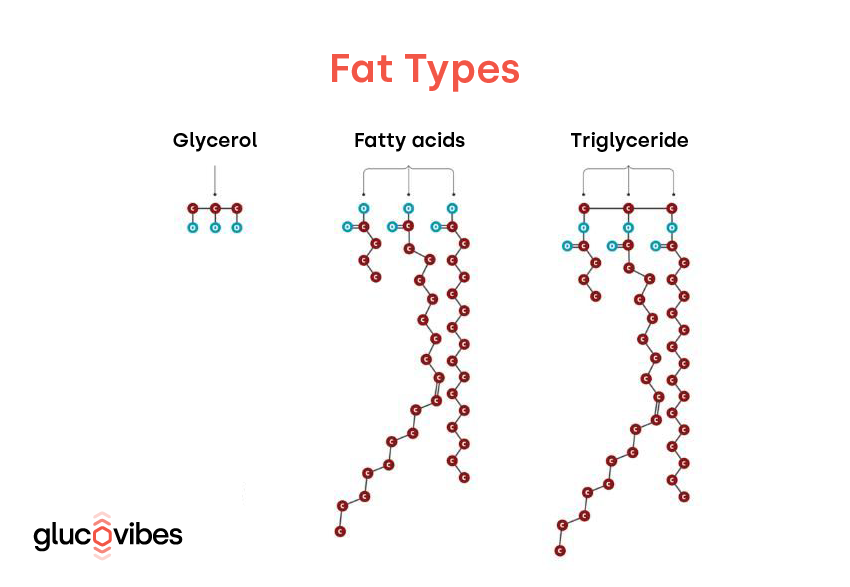
And the remaining 5% of the lipids we consume are known as sterols or phospholipids, the latter being particularly important as they are non-hydrophobic lipids. This means they do not repel water, allowing them to play a crucial role in transporting other fatty acids that cannot dissolve in water, such as carrier proteins.
Fatty acids can be categorized as follows:
- Saturated fatty acids: Primarily derived from animal meat.
- Monounsaturated fatty acids: Generally found in vegetables and plants.
- Polyunsaturated fatty acids: Found in fish and seafood.
The saturation level of a fatty acid is determined by the number of hydrogen atoms attached to the carbon atoms, with saturated fatty acids being those that have no room for additional hydrogen atoms (3). Why is this discussion of hydrogen and carbon atoms relevant here? Because both humans and the food industry have largely created what are known as trans fats, which result from an artificial hydrogenation process applied to monounsaturated fats. This process converts them into products that are easier to handle, last longer, and remain solid at room temperature.
An important detail about monounsaturated fats, such as vegetable oils, is that they are usually liquid at room temperature and oxidize relatively easily, reducing the shelf life of the food. However, through hydrogenation, we can convert a healthy fat like monounsaturated fat into saturated trans fats by filling up the carbon atoms with all the hydrogen atoms they can accommodate in this process. A simple example is margarine, which, although derived from vegetable oils (a healthy monounsaturated fat), becomes trans saturated fats through hydrogenation, making margarine a less healthy fat due to its chemical alteration.
It is also important to note that when we talk about a particular type of fatty acid related to a food, it does not mean that it is the only type of fat it contains, but rather the predominant one. For example, avocado is rich in monounsaturated fatty acids but also contains a percentage of saturated fats. Specifically, for every 100 grams of avocado, there are approximately 29.47 grams of fat, of which 4.27 grams are saturated, 19.7 grams are monounsaturated, and 3.7 grams are polyunsaturated.
Why are fats necessary?
Each gram of fat can generate 9 kcal of energy, whereas a gram of carbohydrate or protein provides 4 kcal of energy.
In other words, a 70 kg person with 11 kg of body fat (energy stored in the body) would need an additional 55 kg of glucose to store the same amount of energy (4). Fat is the body’s optimal form of energy storage and represents an almost limitless energy source, albeit with characteristics different from carbohydrates (glycogen), for example. An interesting feature is that this stored fat does not solely depend on our adipose tissue (commonly known as “love handles”). In fact, the world’s leanest endurance athletes can have more intramuscular fat than an obese person, representing a crucial energy source for human and athletic performance.
Moreover, fats have several key functions in our metabolic system, some of the most important being related to LDL (low-density lipoprotein, commonly referred to as “bad” cholesterol) and HDL (high-density lipoprotein, known as “good” cholesterol). These lipoproteins represent what we understand as cholesterol.
The fact is that, rather than being simply good or bad, LDL cholesterol tends to increase with the consumption of saturated fats, while it tends to decrease with the intake of monounsaturated or polyunsaturated fats, always considering individual and genetic responses. Elevated LDL cholesterol is a risk factor for myocardial infarction (5) because it tends to remain in the bloodstream longer and can adhere to arterial walls, potentially leading to blockages (6). On the other hand, HDL cholesterol tends to lower total blood cholesterol and helps clean the arterial walls of fatty elements.
Figure 2 illustrates the differences between types of fats in various products and thus the concept of harmful or healthy fats based on the predominance of saturated fats and their effect on LDL cholesterol levels.
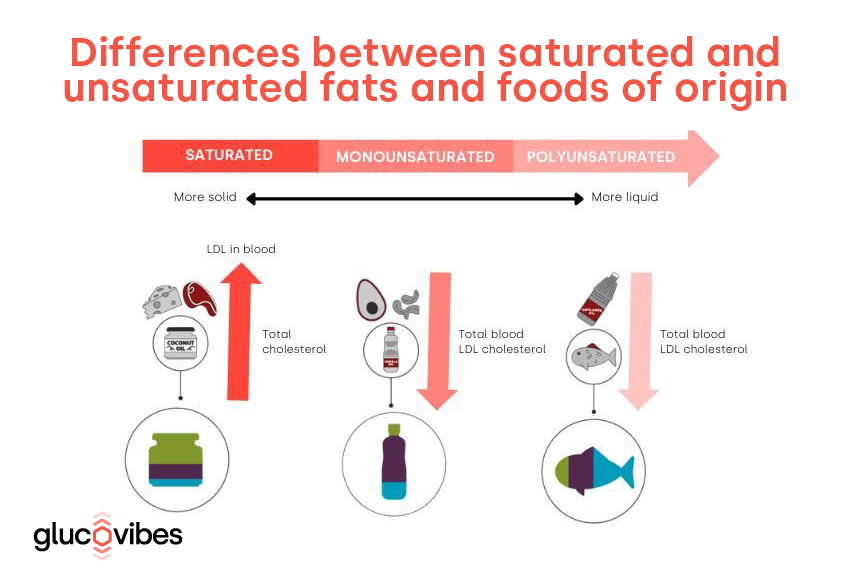
In this context, TRANS fats, which are created through the hydrogenation process mentioned earlier to saturate fats, have the characteristic of increasing LDL cholesterol levels while decreasing HDL cholesterol. This is one of the main reasons why they are detrimental to health (5). Therefore, it’s important to understand the concept of “saturated fats” that you might find on the nutritional information of products available in any supermarket. A higher percentage of saturated fat relative to the total fat content of a product generally indicates that the food is less healthy for our body.

In addition to cholesterol, essential fatty acids, specifically Essential Polyunsaturated Fatty Acids (PUFAs), play a significant role in metabolism. Unlike most fatty acids that our bodies can synthesize, linoleic acid (OMEGA 6) and alpha-linolenic acid (OMEGA 3) are exceptions and must be included in our diet. While deficiencies in these fatty acids are rare, when they do occur, they can lead to cognitive issues in children (7) or slow down wound healing. These two fatty acids are also important components of cell membranes, which act as a barrier between the cell’s interior and its external environment.

From omega-3 and omega-6 fatty acids, the body produces molecules known as eicosanoids. These molecules act as mediators for various functions including the central nervous system, inflammation events, immune responses, and the regulation of blood vessel contraction and dilation (1,8,9). However, the body cannot produce these fatty acids on its own. Where can we find omega-3 and omega-6? Omega-3s can be included in our diet through the consumption of fatty fish such as tuna, salmon, and sea bass, as well as seafood, avocados, plant oils like olive oil, and nuts. Omega-6s are primarily found in vegetable oils (some of which are used in supplements like evening primrose oil) and also in certain nuts such as almonds, peanuts, cashews, and pistachios.
Fats as an energy source
We have previously discussed that for each gram of fat, our body can generate 9 kcal, whereas for each gram of carbohydrate, our body generates 4 kcal. Does this mean that burning fat is better than burning carbohydrates to fuel our body? In earlier entries, we examined the metabolic basis of blood glucose levels and the effects of physical exercise on glucose levels.
It is important to note that each organ has a preferred fuel source. For example, the brain primarily uses glucose for energy and only resorts to fatty acid reserves to produce ketone bodies in cases of starvation or prolonged fasting, when the body cannot supply the brain with the glucose it needs (which is around 120 grams daily). This is a temporary emergency measure (10). Clinical evidence exists on the impact of ketones on brain disorders, but such cases require professional medical supervision throughout any fasting or starvation process to induce this conversion of fatty acids into brain fuel (11). Additionally, studies in children have shown that glucose intake can enhance their attention capacity (12).

In the case of muscles, a similar principle applies. While muscles do have a higher propensity to use fatty acids as a source of energy, glucose is the preferred and optimal fuel during exercise. Conversely, during periods of inactivity and rest, fatty acids play a more significant role in supplying energy to the muscles, potentially accounting for up to 85% of their energy needs under normal conditions (10).
What is clear is that our metabolic system is a perfectly functioning machine with its own preferences and priorities. Glucose serves as the primary fuel source, with fats acting as a reserve energy source when the main fuel is depleted.

And how do fats affect blood glucose levels? Several studies (13) have shown that diets high in saturated fats tend to increase postprandial (after meal) glucose levels, sometimes even more acutely than added sugars. However, studies conducted with controlled subjects reveal a certain delay in this effect on glucose levels due to the slower digestion process of fats (14). Therefore, fats and their characteristics also influence glucose values.
Conclusions
It is very important to understand that a diet high in healthy fats (monounsaturated and polyunsaturated) does not have to be detrimental to health. In fact, the Mediterranean diet serves as a successful example of a healthy diet with a high presence of beneficial fats. However, the trend of low-fat diets that substitute calories with simple sugars or processed carbohydrates with lower caloric impact may be less healthy, a topic we will discuss another time. This is always in the context of the physical activity we engage in, as our body requires glucose during activity.
On the other hand, fats are also a key energy source for the body, providing reserves for times when additional energy is needed or when carbohydrate intake is insufficient, given that carbohydrates are the primary fuel for the body’s main organs. Additionally, fat is the optimal form of energy storage for our body, and its intake affects blood glucose levels as we have discussed.
Thank you for reading, and see you next time!
References
- [1] (Sizer & Whitney, 2017)
- [2] American Heart Association, 2014)
- [3] (Saig, 2014)
- [4] Berg Tymoczko & Stryer, 2002)
- [5] (American Heart Association, 2017b)
- [6] (Feingold & Grunfeld, 2018)
- [7] (Morley, 2018)
- [8] (Swanson, Block & Mousa, 2012)
- [9] (National Center for Biotechnology Information, 2004b)
- [10] Biochemistry. 5th edition, section 30.2, https://www.ncbi.nlm.nih.gov/books/NBK22436/
- [11] Crit Care. 2011; 15(2): 219. Clinical review: Ketones and brain injury
- [12] David Benton et al, 1987, Biological Psychology Volume 24, Issue 2, Pages 95-100, https://www.sciencedirect.com/science/article/abs/pii/0301051187900160
- [13] Siôn A Parry et al., 2020. https://pubmed.ncbi.nlm.nih.gov/32165444/
- [14] Mary C. Gannon and Frank Q. Nuttall, 2004) https://pubmed.ncbi.nlm.nih.gov/25998293/