

How does affect stress to your glucose levels?

Have you ever stopped to think about how stress can affect your metabolism?
Today we’re diving into that topic, using an example you can apply to many other situations which I’ll explain at the end of this post.
Your body is designed to switch on during moments of alert. It prepares for the well-known “fight or flight” response, that is, to run or to fight. Both require energy, and that’s why, when your body senses stress, danger, or tension, it activates cortisol.
Cortisol, energy and stress
Cortisol triggers a series of mechanisms in your body, which I’ll try to explain simply:
- Releases glucose into the bloodstream: It stimulates the liver to produce glucose (gluconeogenesis) from proteins and fats, preparing the body for immediate action.
- Inhibits glucose uptake in tissues: It reduces insulin sensitivity, meaning less glucose enters the cells, keeping it available in the blood. The body expects this glucose to be used by your muscles.
- Increases energy availability: It also mobilizes fatty acids from fat stores to be used as an alternative fuel.
And without activity?
But what does your body do if, in those stressful situations, you’re not using your muscles?
When stress is psychological or emotional and chronic (like an argument, work overload, or constant worry), but your muscles are not activated, the following happens:
- Glucose is not used, because there is no real muscular movement.
- The pancreas releases insulin to remove the excess glucose from the bloodstream.
- That glucose gets stored as fat, mainly around the abdominal area.
- Over time, this can lead to insulin resistance, chronic inflammation, and a higher metabolic risk.
And to help you see it firsthand, here’s an example of the same high-carbohydrate meal in two different situations: one under work-related stress, and the other in a calm, relaxed setting after lunch.
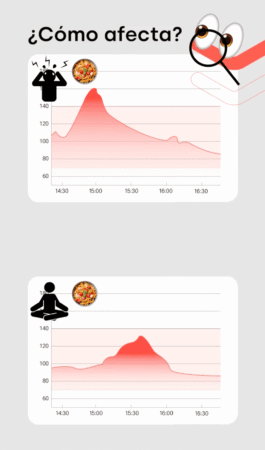
As you can see, the top image shows a much higher spike, even exceeding hyperglycemia levels, while the bottom image shows a glucose peak solely related to the meal.
The meal is a pasta salad, and when combined with a cortisol-driven stress response, it results in a double glucose input , one external (from the food) and one internal (produced by cortisol).
Since cortisol also reduces insulin sensitivity during those moments of activation, the resulting spike is even higher.
So now you know, manage stress with simple tricks like breathing exercises or a short walk during tense moments. That way, your muscles help regulate glucose levels.
You could also go for a run or jump around , that would be a literal fight or flight response! 😉