

Impact of a Prepared Salad
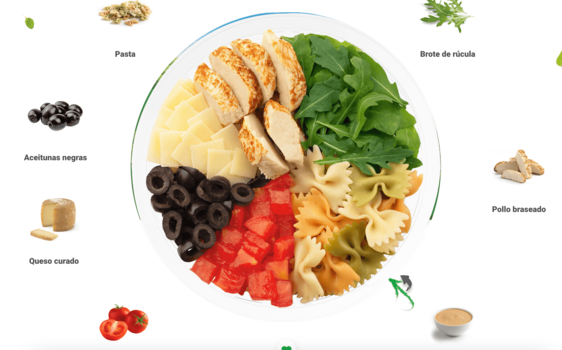
Salads are always healthy choice, or not?
Like many people, you might think any salad option is light, has a low metabolic impact, and is therefore healthy. Today I’m sharing a real-life example: a Florette salad—specifically the one you see in the image—made with pasta and arugula. It includes black olives, tomato, chicken breast, and a bit of cheese, along with the pasta and arugula. The salad comes with a small packet of dressing: a tomato and basil vinaigrette, according to the package.
As you can see in the nutritional info per 100g—and considering the full salad weighs 315 grams (including the dressing)—it exceeds 600 kcal, with 72g of carbs, 25g of fat, and 22g of protein.
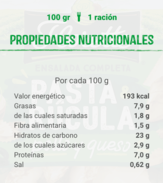
In this case, the dressing was not consumed—only the salad itself, without sauces or dressings, accompanied by 2 corn cakes. Based on Glucovibes’ food database calculations, the intake amounted to 446 kcal, with 50g of carbs, 14g of fat, and 25g of protein.
If you do the math, you’ll see that the dressing alone contributes to 50% of the total carbs, mainly from added sugars, and over 50% of the fat content. You’re probably wondering about the glycemic impact and the resulting glucose curve. Here it is:
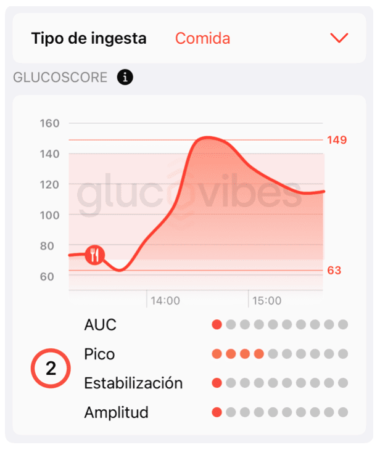
A GlucoScore of 2, with a peak up to 150 mg/dL—nearly doubling pre-meal glucose levels. Does this mean the salad isn’t healthy? Not necessarily. And to be fair, it wasn’t just the salad—the corn cakes also contributed to the spike. However, as shown, the combination of the refined pasta and low fiber content likely drove this curve. Notice too that two hours later, glucose levels were still close to 120 mg/dL—likely due to fats from the olives and cheese. Glucose returned to baseline 30 minutes later.
What’s clear is that including the dressing, which—as mentioned—adds a lot of fat and simple sugars, would likely have made the impact even greater.
Remember 💾
Nothing beats homemade, where you control every ingredient. This salad could be a better choice with whole wheat pasta cooked the day before, a handful of mixed seeds to increase fiber, and a homemade dressing with olive oil or avocado. Keep the following in mind:
- Try to cook at home whenever possible.
- Choose whole grain options for cereals and derivatives.
- Be cautious with commercial sauces and dressings—they’re often full of added sugars and unhealthy fats.
- When eating out, try to increase fiber intake.
- Go for a walk after meals, especially when eating out.
And don’t forget—you can send us suggestions and feedback to test new foods, or even better, try it yourself with one of our VIBER plans.