

Why miracle diets won’t help you lose weight
Spending less time watching Netflix, reading more, learning a new language, learning to cook, losing weight… Sound familiar? With the new year coming in, we make many resolutions (in case you missed it: at Glucovibes, we recommend 12 realistic and healthy resolutions to ensure a sweet and healthy year). To achieve some of these, like ‘losing weight,’ many people turn to ‘shortcuts,’ such as diets promising to lose 5 kg in 3 days. Wonderful, right? So if I follow this diet for 10 days, will I lose 10 kg? It doesn’t work that way: miracle diets won’t help you lose weight in the long term in a healthy or balanced way.
We want to explain why these diets are ineffective, how to identify them, and finally, offer you the 4 best tips for losing weight in a healthy and natural way.
Why they aren't effective
Simply put, they are not sustainable in the long term. This is partly due to how extremely restrictive they are. For example, the oatmeal diet basically involves eating only oatmeal. Do you think this is sustainable? Would you stick to this for 6-12 months? We’re sure you wouldn’t. If you think you could, let us give you two pieces of advice:
- Don’t even try it.
- Read the full post.
Firstly, you should know that the only requirement for losing weight is to create a negative energy balance. In other words, you need to expend more energy than you consume.
It’s true that most of these miracle diets cause rapid weight loss. But this effect is due to the negative energy balance they create, not necessarily to the foods they recommend per se. If you aren’t losing weight despite being on a diet, by definition, you are not in a negative energy balance.
Think of energy balance like a scale. On the left side, you have the energy you intake. This side of the scale is influenced only by the amount of food you eat. On the other side, you have the energy you expend. This side includes several factors: basal metabolic rate, NEAT (non-exercise activity thermogenesis), the thermic effect of food, and physical exercise.
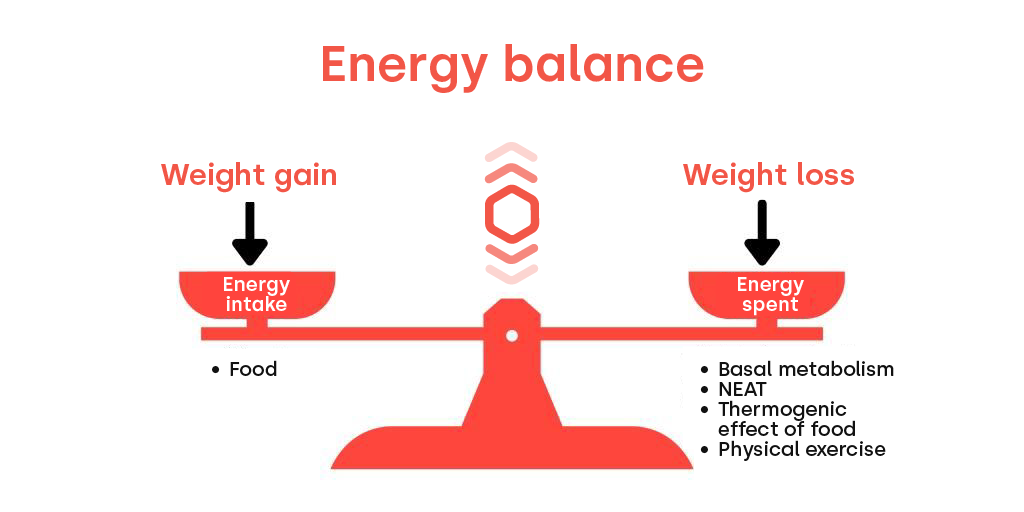
The only healthy way to lose weight is to create a negative energy balance.
Imagine that by consuming 2000 kcal and walking 7000 steps a day, you maintain your weight. This means that while you follow this routine, you are in an energy-neutral balance: you intake 2000 kcal but also expend 2000 kcal. On the other hand, if instead of driving to work, you walk or park a couple of blocks away, you will be more active throughout the day and thus create a negative energy balance.
If you maintain your intake at 2000 kcal but now walk 14000 steps a day, what do you think will happen? You will lose weight because you are burning more kcal. The same applies if you reduce your calorie intake to 1800 kcal instead of increasing the number of steps you take each day.
What do these two situations have in common? In both, you are expending more calories than you consume (thus creating a negative energy balance).
In the first situation, being more active throughout the day causes you to burn more calories: if you consume 2000 kcal and expend 2200 kcal, you are creating a negative energy balance of -200 kcal. If we look at the scale, this extra expenditure would be attributed to an increase in physical activity. In the second situation, you consume 1800 kcal and expend 2000 kcal. Therefore, in this case, you achieve the negative energy balance by reducing the calories you intake. Ultimately, you are creating the same effect: a negative energy balance of -200 kcal.
Additionally, they don’t tell you that there are essential nutrients that must be included in your diet. These include certain fatty acids and amino acids. Fatty acids can be found in fats such as oils, nuts, and fatty fish, while amino acids are found in protein-rich foods like meats, fish, eggs, and dairy products.
So, a requirement for any diet is that it must at least provide essential nutrients in adequate amounts. This means it will need to include fatty foods to provide essential fatty acids and protein-rich foods to supply essential amino acids. Continuing with the example of pineapple, it does not contain either of these essential nutrients. Do you still believe it is a suitable option for weight loss?
How to identify a miracle diet
Identifying these types of diets is relatively easy. They often use the testimonial of someone whose “results” have been extraordinary as a hook. We put “results” in quotes because we seriously doubt that these results were achieved through these “diets.” Anyone with even a basic understanding of nutrition would agree that these protocols should not be called diets.
Although there is no consensus on what constitutes a miracle diet, these practices typically share certain common characteristics (1):
- They promise rapid weight loss. At first, this sounds appealing.
- They tend to be very restrictive. For example, the oat diet allows you to eat almost exclusively oats. The pineapple diet consists of eating only pineapple. The same goes for the artichoke diet, the maple syrup diet, the tuna diet, and so on.
- They sometimes feature endorsements from celebrities. (Have you seen any football players promoting weight control products?)
- There is often a rebound effect when you finish them. If you know someone who has tried one of these diets, they’ve likely experienced the dreaded “rebound effect.” This effect is nothing more than the predictable and logical consequence of returning to old eating habits. What’s the point of eating only pineapple for two weeks if you go back to your old habits afterward? None.
We’ve introduced an extremely important word here: habits. These are key to losing weight healthily and maintaining the weight lost over time.
4 tips for losing weight healthily
If you’ve made it this far, you’re truly interested in learning how to lose weight healthily without resorting to unsustainable diets. Here are 4 tips that will be very useful for you to put into practice and achieve your goal:

Losing weight should not come at the expense of your health or happiness: finding a balance is key.
- Create a negative energy balance. This is the only rule you need to follow. You can achieve this in various ways, as explained in the previous example. From my perspective, the first option would be to try to be more active throughout the day: walking to places, going for walks with friends, taking the stairs, or walking the dog are all examples of how to increase your daily activity. If you typically take 7,000 steps a day, aim to increase this to 15,000.
The results will be fantastic and may surprise you. Additionally, remember that besides being more active, engaging in physical exercise is also important. Riding a bike twice a week could be a good option. Another example is going to the gym and doing strength training. Choose the exercise that best suits your circumstances.
- Include sufficient protein in your meals. Protein is the most important nutrient for losing weight and later maintaining the lost weight (2). By sufficient protein, I mean consuming around 2 g/kg/day. If you weigh 70 kg, this would be equivalent to consuming 140 g of protein per day. Besides its satiating effect, protein helps maintain muscle mass (3).
I recommend spreading your protein intake over 3-5 meals throughout the day, depending on your habits and personal preferences. For example, if your goal is to consume 140 g of protein daily and you decide to divide it into 4 meals, each meal should contain 35 g of protein. Here is a list of protein-rich foods to help you:
- White meats: chicken, turkey, rabbit
- Red meats: beef, pork, horse
- White fish: cod, hake, sole
- Blue fish: sardines, salmon, tuna, bonito
- Eggs
- Dairy products
- Legumes
- Add fruits and vegetables to every meal. These foods are characterized by their low energy density (providing few calories per gram). They are high in fiber, which is crucial for keeping you full for longer. The advantage is that you can eat a large volume of vegetables while consuming very few calories.
I recommend that your first course always be vegetable-based, such as:
- Salads
- Roasted vegetables
- Escudella
- Purees
- Soups
Also, prioritize fruits as desserts whenever possible. The underlying reason is the same as with vegetables: they generally have a low energy density and are a good source of fiber.
- Be patient. Miracle diets are “short-term solutions with long-term hunger.” While you might see weight loss on the scale initially, as soon as you stop the diet and return to your old habits (i.e., eating ‘normally’), you will regain the lost weight. Moreover, weight lost in the first few days is mostly glycogen and water, not fat.
In contrast, if you try to change your habits and these changes are easy to implement, it’s more likely that these changes will be maintained over time. Making better dietary choices to ensure adequate protein intake is a simple change to make. Using the stairs instead of the elevator, or walking or biking to places whenever possible, are also easy to incorporate.
Some people may prefer to reduce their food intake to create a negative energy balance. Others might choose to be more active during the day or start a specific sport. All options are valid. The only thing you need to do is choose the one that best fits your life so you can maintain it over time.
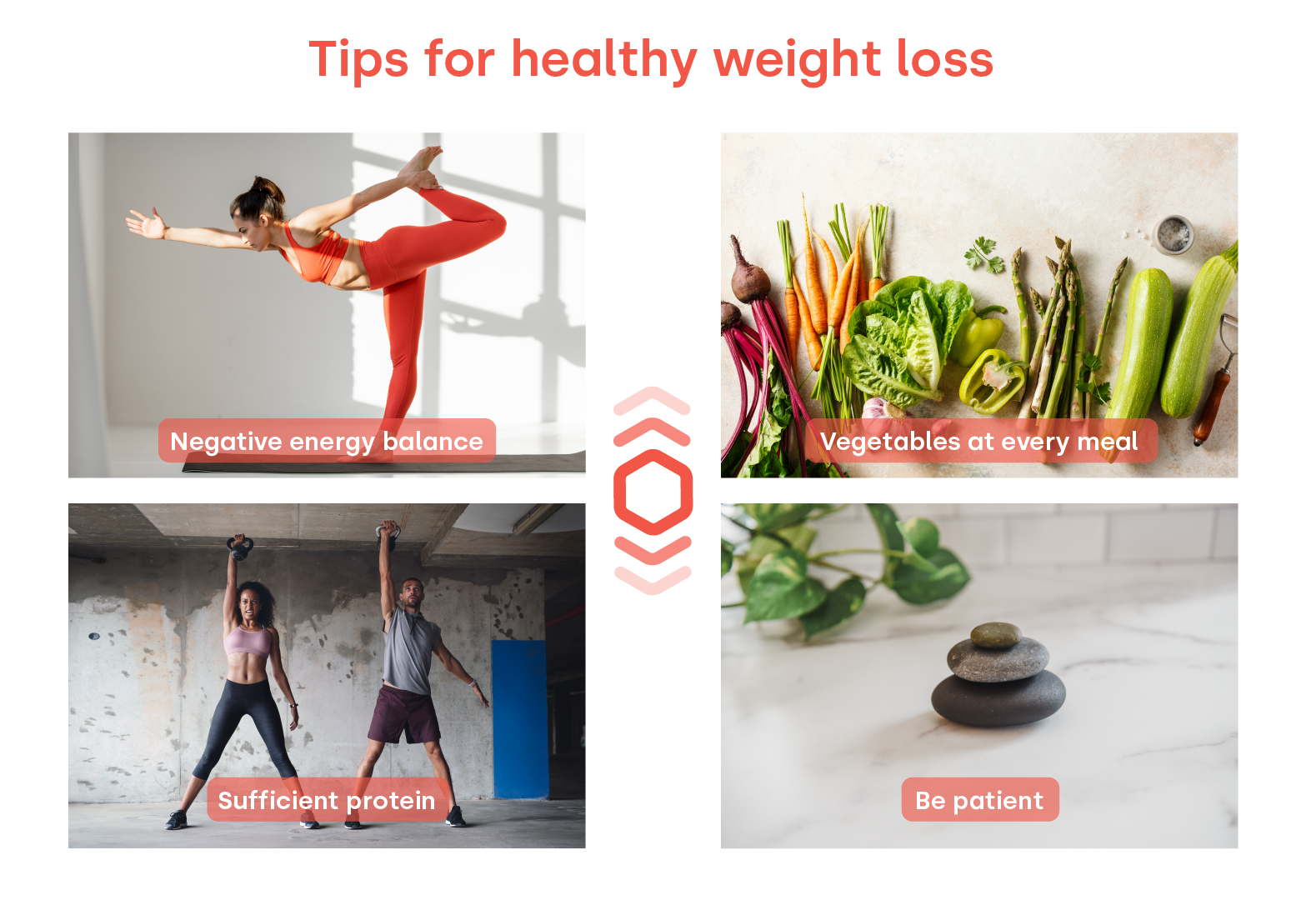
These small habits are essential for losing weight in a healthy way and maintaining the weight loss.
In conclusion, we hope we’ve helped you realize that following these types of diets isn’t the best way to achieve your desired weight. At the same time, we hope we’ve provided you with some steps to help you reach your goal.
Remember, you don’t have to reinvent the wheel to succeed. The recipe for success is already known, and we know the key ingredients:
- Negative energy balance
- Sufficient protein intake
- Adding fruits and vegetables to your diet
- Patience
References
- [1] Basulto J, Manera M, Baladia E, Miserachs M, Rodriguez VM, Mielgo-Ayuso J, et al. ¿Cómo identificar un producto, un métdo o una dieta “milagro”? Grup Revisión, Estud y Posicionamiento la Asoc Española Dietist [Internet]. 2012;2012:14. Available from: http://www.fedn.es/docs/grep/docs/dietas_milagro.pdf
- [2] Van Baak MA, Mariman ECM. Dietary strategies for weight loss maintenance. Nutrients. 2019;11(8):1–12.
- [3] Layman DK, Evans E, Baum JI, Seyler J, Erickson DJ, Boileau RA. Dietary protein and exercise have additive effects on body composition during weight loss in adult women. J Nutr. 2005;135(8):1903–10.